
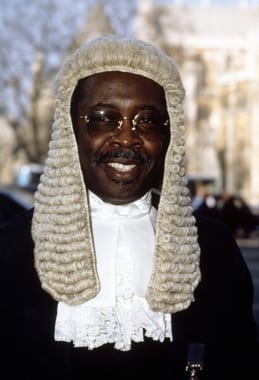
The former High Court judge is believed to be the first person of African ancestry to be made a Queen’s Counsel (or QC) in England and Wales.
Dr Roberts CBE, QC was a man credited with many firsts, the most notable being the first person of African ancestry to be appointed by the British Government to serve as a High Court judge of the Supreme Courts of the British Virgin Islands, and Anguilla, British West Indies in 1992.
Born in Sierra Leone on 17 May 1928, he was a keen pianist, organist, guitarist and choir singer, who was passionate about helping people. So eager was he to serve his people that he is reputed to have been the first head of Chambers to allegedly accept seven female barristers all at once, unheard of in 1975.
Many regarded him as a modest humble man who refused to push himself forward. However many are of the view it was this attitude coupled with his unparalleled self-belief that enabled him to achieve the distinction of being the first person of African ancestry to become the Head of his Chambers in England and Wales.
His Chambers at 2 Stone Buildings was fully representative, mixed and diverse with Asian, white and African and Caribbean members. He jocularly remarked at a special event held in his honour at the House of Commons in 2007 that at one point there were more white staff than ethnic minority on his team.
Dr Roberts is the great grandson of the first President of Liberia, Joseph Jenkins Roberts. In his earlier life he was an RAF pilot with accounting qualifications. He was posted to Europe, the Near East, the Far East and the South Pacific as part of his RAF duties until 1962. When not on duty he was an avid boxer and sprinter. Immediately after his service in the RAF, he was invited to serve in the Sierra Leone Civil Aviation Service by the Prime Minister of Sierra Leone, where he worked in the Air Traffic Control Services Department until 1964.
Following his marriage in 1961 to a Jamaican nurse, the couple had a son before they returned to the UK where he worked as a Civil Servant between 1964 and 1969. During this time he read law part time at the Inns of Court School of Law, affirming his love for helping people. He was called to the Bar (Gray’s Inn) in 1969, becoming a Master of the Bench in 1996. In 1972 he became a Member of Lincoln’s Inn.
In addition to the English Bar, Dr Roberts may have set a record by being called to the Bars of ten other countries, namely: Jamaica (1973), Sierra Leone (1975), Trinidad & Tobago (1978), Bahamas (1984), St Kitts & Nevis (1988), Antigua (2002), Barbados (2002), Bermuda (2003), Anguilla (2006) and Grenada (2007).
In recognising his many accomplishments, he has not only distinguished himself as a legal giant, but he has made the African Caribbean community extremely proud by being the first person of African ancestry to be made a Recorder of the Crown Court in England and Wales.
Dr Roberts, in keeping with his desire to empower his people, accepted the role of Bencher of the Council of Legal Education in Sierra Leone in 1990; and tutored on Advocacy for a period between 1990 and 1992 at the Inns of Court School of Law in London.
As a means of remaining active Dr Roberts served as a former President of the British West Indian Ex-Servicemen and Ex-Service Women’s Association along with serving as a former joint President of the British Caribbean Association UK.
Other accolades accorded to him include being made an Honorary Citizen of Atlanta, Georgia, USA in 1991; a Freeman of the City of London in 1996; an Honorary Citizen of the British Virgin Islands in 2000; and then receiving an Honorary Doctorate from City University in 1996. He also served as a fellow of the Chartered Institute of Arbitrators and sat as an arbitrator and a door tenant at Warwick Court Chambers for some years.
Arguably his crowning achievement was being awarded a Commander of the British Empire (or CBE) in the New Year’s Honours in 2011. Dr Roberts received this award for the Administration of Justice, Diversity and Equal Opportunities.
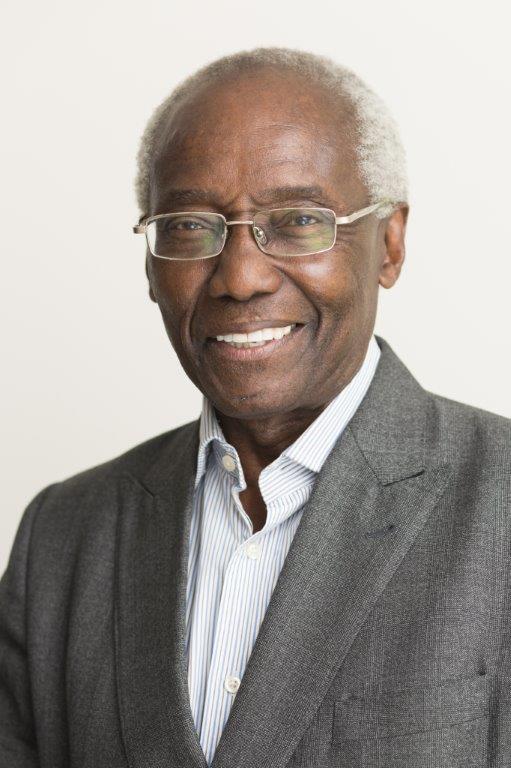
Sir Godfrey, also known as Geoff, is Professor Emeritus in the School of Life Sciences at Heriot-Watt University in Edinburgh, Scotland. He was born in St. Elizabeth, Jamaica but grew up in Allman Town, Kingston before migrating to London to join his mother at the age of 14 to help her by working in a local grocery shop in Islington in 1955. However, he was not allowed to work because he was below the school-leaving age of 15 years. Overcoming early educational challenges of being assessed as “educationally subnormal” at school in London, and despite other difficulties, he completed school at Highbury County, London in 1958. He excelled at cricket as a member of the prestigious London School Boys Cricket team, having learnt his cricketing skills at Race Course, Kingston, Jamaica. After leaving school in 1958, Sir Godfrey secured a job at Queen Elizabeth College as a junior technician.
Godfrey's employer, Professor Garth Chapman, who was instrumental in changing Sir Godfrey name, from Godfrey to Geoff, helped him to get a place at Leicester University because, although fully qualitied, he was rejected by the Universities he had applied to enter in 1961. He went on to earn an honours degree in botany in 1964 from Leicester University. After completing his degree at Leicester University Sir Geoff returned to Haringey, London to secure a job.
However, the only suitable job offered was to peel potatoes in Beales restaurant at Nags Head in North London. He worked there for about six months. He applied for a joint PhD in grain science and technology at Heriot-Watt College and Edinburgh University. He started his PhD in 1965 and completed it in 1967 and then worked as a Post-Doctoral Fellowship at the Heriot Watt University from 1967 to 1968. His supervisors were Professor Anna MacLeod at the Heriot Watt University and Sir Edmund Hurst at Edinburgh University.
In 1968 he began his research work at the Brewing Research Foundation in Surrey, England where he worked on the science and technology of barley from 1968 to 1977. There he discovered the Barley Abrasion Process (1969) and was the first to use the Scanning Electron Microscope to study malt production in detail. The Abrasion process was patented and used by the British Brewing Industry. He was employed by the Heriot Watt University as a lecturer in 1977. In 1989 he designed, edited and contributed to his textbook, entitled Cereal Science and Technology. In 1991 Sir Geoff gained his Professorship and served in Japan as Visiting Professor at Kyoto University.
In addition to his active involvement in the science and technology of cereal grain research, Sir Geoff found it possible to help to secure better education opportunities for Black and minority ethnic children in the early 1970s by writing a series of articles for the Times Educational Supplement, explaining the educational needs of these children. Professor Sir Geoff Palmer's important Life Scientific interview by the BBC, Radio 4, in August 2015 gives some examples of the difficulties he had to over-come to succeed.
During his working life Sir Geoff has travelled and lectured worldwide and was instrumental in the development of the Tropical cereal sorghum, as brewing material and food in Africa, making various trips to Nigeria, Kenya, Zimbabwe and South Africa. He helped to secure the first export of British barley to China and has lectured on barley, malt and cereal grains in many countries such as Canada, the United States, Brazil, Jamaica, St Lucia, India and most European countries.
On his retirement in 2005 he was made Emeritus Professor of the Heriot-Watt University. He has accepted Honorary Doctorates from a number of Universities including two from Universities in Jamaica. He is a Fellow of various institutions such as the Royal Society of Medicine. Sir Geoff is currently a Fellow of the Institute of Brewing in London, one of the first Fellows to be elected. He donated his certificate to the Red Stripe Brewery in Kingston, Jamaica. He is a Freeman of Midlothian County, Scotland and he was given the Good Citizen Award of Edinburgh, Scotland for his work on race relations. He is also a Black Enterprise Champion award winner.
Sir Geoff is still actively involved in science and technology and has recently (2015/2016) completed chapters for books on Distilled Beverage and Barley and Malt. He is the author of a book on race relations: Mr White and the Ravens and a book on Caribbean (Jamaican/Scottish) history: The Enlightenment Abolished. He is a past Visitor (and Chairman) of the Incorporation of Maltmen of Glasgow, Scotland an old charitable organisation.
Professor Sir Geoff Palmer is actively engaged in charitable work in the community and continues to work to help deprived children on a charitable basis. He is Honorary President of Edinburgh and Lothians Regional Equality Council and Birmingham's Association of Jamaicans. He was a prison visitor for many years and is on the Board of Sacro, an organisation that works to reduce offending. As a Board member of the Citizen Advice Bureau and Hanover Housing for older people he works to help a wide range of people in the community. However, he also continues to support his past Church and School at North Street/Princess Street in Kingston.
In 1998, Sir Godfrey was the fourth person (and at the time the only person in Europe) to be awarded The Distinguished American Award for his research on cereals, regarded in the industry as its Noble Prize Award. In 2003 he obtained the OBE (Order of the British Empire) for scientific and charitable work. He was awarded a Knighthood in the New Year's Honours list of the United Kingdom in 2014 for his work in science, human rights and charity. Sir Geoff is also a patron of Reach Society.
In 2024 Sir Geoff was made a Knight of the Thistle by King Charles III, which is Scotland's highest honour to any civilian.
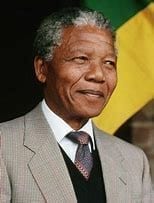
Nelson Rolihlahla Mandela was born July 1918 into the Xhosa tribe in South Africa. He was a South African anti-apartheid revolutionary, political leader, and philanthropist who served as President of South Africa from 1994 to 1999. Mandela was the country’s first Black head of state and the first elected in a fully representative democratic election. His government focused on dismantling the legacy of apartheid by tackling institutionalised racism and fostering racial reconciliation.
Ideologically an African nationalist and socialist, he served as President of the African National Congress (or ANC) party from 1991 to 1997. Mandela was of the Thembu royal family in Mvezo, British South Africa. He studied law at the University of Fort Hare and the University of the Witwatersrand before working as a lawyer in Johannesburg.
There he became involved in anti-colonial and African nationalist politics, joining the ANC in 1943 and co-founding its Youth League in 1944. After the National Party’s white-only government established apartheid, a system of racial segregation that privileged whites, he and the ANC committed themselves to its overthrow.
Mandela was appointed President of the ANC’s Transvaal branch, rising to prominence for his involvement in the 1952 Defiance Campaign and the 1955 Congress of the People. He was repeatedly arrested for seditious activities and was unsuccessfully prosecuted in the 1956 Treason Trial.
Influenced by Marxism, he secretly joined the banned South African Communist Party (SACP). Although initially committed to non-violent protest, in association with the SACP he co-founded the militant Umkhonto we Sizwe in 1961 and led a sabotage campaign against the government. In 1962, he was arrested for conspiring to overthrow the state and sentenced to life imprisonment in the Rivonia Trial.
Mandela served 27 years in prison, split between Robben Island, Pollsmoor Prison, and Victor Verster Prison. Amid growing domestic and international pressure, and with fears of a racial civil war, President F. W. de Klerk released him in 1990.
Mandela and de Klerk led efforts to negotiate an end to apartheid, which resulted in the 1994 multi-racial general election in which Mandela led the ANC to victory and became President of South Africa. Leading a broad coalition government which asserted a new constitution, Mandela emphasised reconciliation between the country’s racial groups and created the Truth and Reconciliation Commission to investigate past human rights abuses.
Economically, Mandela’s administration retained its predecessor’s liberal framework despite his own socialist beliefs, also introducing measures to encourage land reform, combat poverty, and expand healthcare services. Internationally, he acted as mediator in the Pan Am Flight 103 bombing trial and served as Secretary-General of the Non-Aligned Movement from 1998 to 1999.
He declined a second presidential term and in 1999 was succeeded by his deputy, Thabo Mbeki. Mandela became an elder statesman and focused on combating poverty and HIV/ AIDS through the charitable Nelson Mandela Foundation.
Mandela was widely regarded as an icon of democracy and social justice, he received more than 250 honours - including the Nobel Peace Prize - and became the subject of a cult of personality. He is held in deep respect within South Africa, where he is often referred to by his Xhosa clan name, Madiba, and described as the “Father of the Nation.”